TailorMate
Tailoring is personal, but the experience around it is often unclear and hard to trust. TailorMate was designed to bring structure, transparency, and confidence to the entire process, from finding a tailor to receiving your outfit.
Client
Bob Thomas, Sparkline Solutions
Service Provided
Product Design, Mobile App Design, UX Strategy, Information Architecture

The Problem
At first, the product looked simple.
Find a tailor.
Place an order.
Get your outfit.
But once we started mapping the experience, it became obvious that tailoring isn’t a simple flow.
There are multiple layers:
measurements, garment types, delivery, communication, expectations…
The challenge wasn’t designing screens.
It was making all of that feel easy.
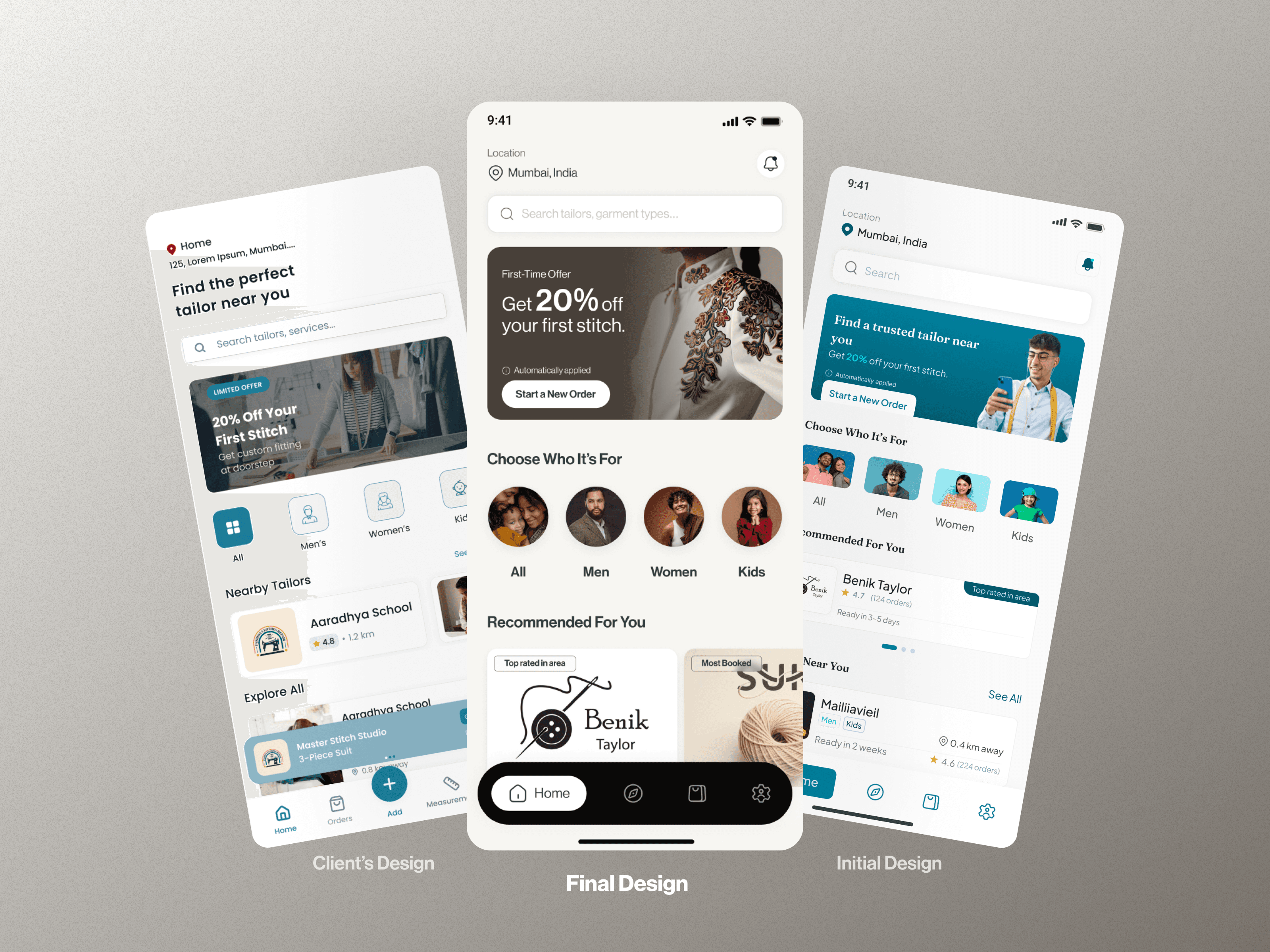
The first version — clear, but not quite right
The initial design leaned heavily on structure.
Everything was functional.
Everything made sense.
But something felt off.
It started to feel a bit too techy.
It didn’t reflect what tailoring actually is — something human, crafted, and personal.
That was the first turning point.
Rethinking both flow and feeling
At that point, it wasn’t just about improving UI.
We had to rethink two things together:
How the product works
and
How it feels
Because both were affecting each other.
While the structure needed to stay clear, the experience needed to feel:
calm, reliable, and crafted — not cold or overly system-driven.
Simplifying the experience
One pattern kept showing up.
Every time we tried to include everything, the experience became heavier.
So I made a decision early on:
Not everything needs to be visible at once.
It just needs to be easy to find when needed.
This shaped how the home, discovery, and navigation were designed.
1
Making the Product Easier to Understand
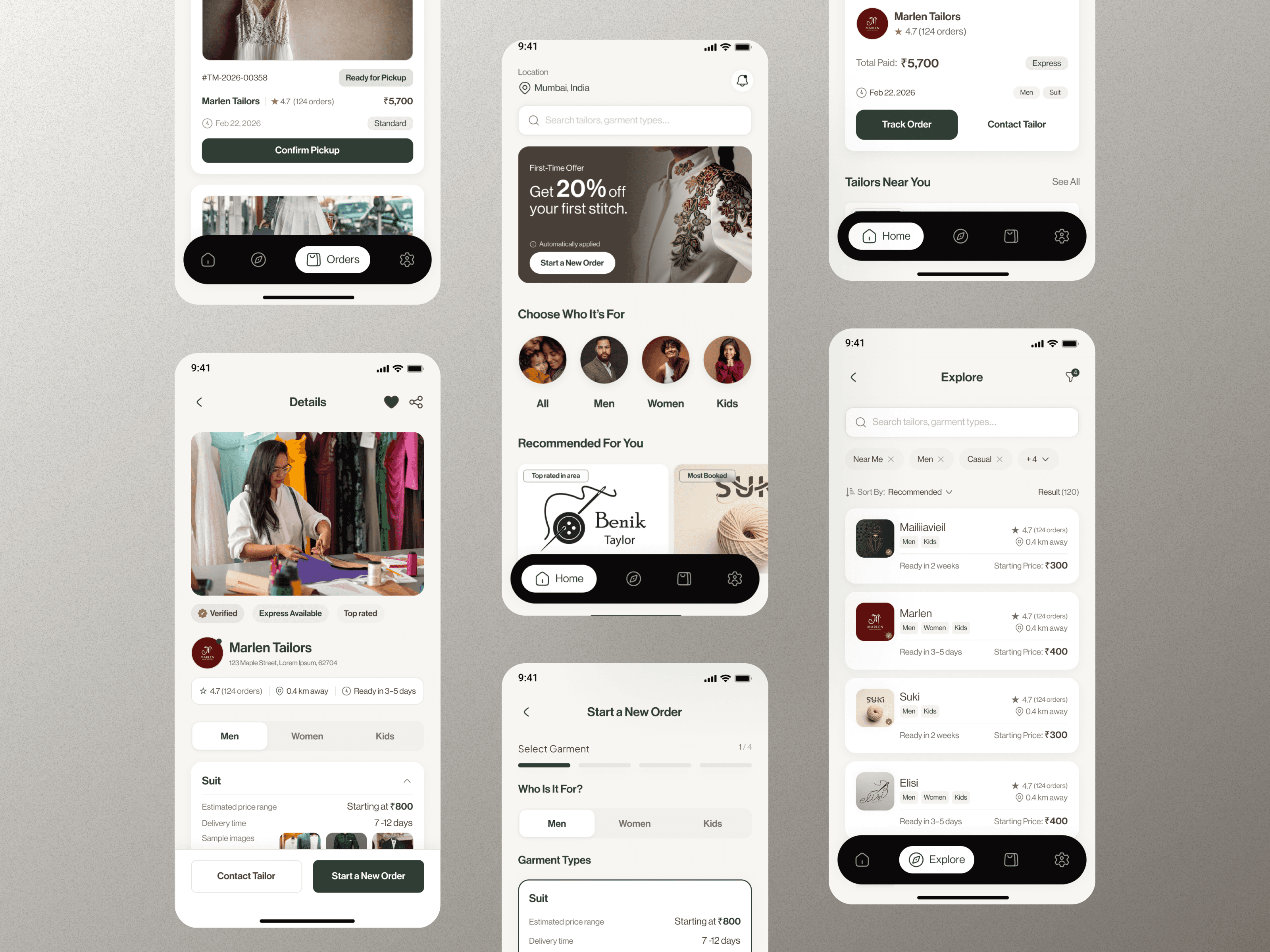
One of the biggest improvements came from simplifying navigation.
Instead of having multiple entry points leading to different pages, everything was centralized into one browsing experience.
The explore page became the core of discovery.
What changes is what the user sees — not where they go.
It made the product feel more predictable and easier to learn.
Handling complexity in the order flow
The order flow was where things could easily break.
There were quite a number of inputs required:
who the outfit is for, garment type, preferences, measurements, delivery…
If handled poorly, it would feel long and tiring.
So instead of stacking steps, I started merging related decisions.
For example, selecting who the outfit is for and the garment type happens together.
Small changes like this reduced friction without removing important detail.
A shift that changed the experience
One of the most important decisions came when I rethought the completed order state.
Initially, the focus was on the process — the tracker, the steps, the progress.
But then I asked:
When the outfit is ready, what does the user actually want to see?
Not the process.
The result.
So I changed the structure.
The final outfit comes first.
The process becomes secondary.
That single change made the experience feel more rewarding.
The visual direction — and getting it right
The visual direction didn’t come together immediately.
We explored warmer, more expressive styles at some point, but they started to feel slightly loud and less grounded.
There was some back and forth here.
Trying to balance something visually engaging with something that still felt aligned with tailoring.
So I stepped back and reframed the question:
What should this product feel like?
The answer was clear:
calm
trustworthy
refined
That led to a more grounded visual direction that better supports the product.
2
Outcome
There were moments where direction had to shift based on feedback, especially around onboarding.
The preferred layout was simpler and more familiar than what I initially explored.
So instead of restarting completely, I adapted the structure while maintaining the system.
Typography, spacing, and overall feel stayed consistent.
That way, even with changes, the product still felt cohesive.
What this became
By the end of the process, TailorMate felt more intentional.
Less crowded.
More guided.
Easier to move through.
It takes a complex process and makes it feel manageable.
And more importantly, it builds confidence in the experience.
Key Takeaways
This project reinforced something important for me.
Design isn’t always about adding more.
It’s about knowing what to simplify, what to adjust, and what to let go of.
And sometimes, the biggest improvements come from stepping back and rethinking the direction entirely.
Closing Reflection
TailorMate wasn’t just about designing screens.
It was about shaping how a complex, personal service can feel clear and reliable in a digital space.
And that’s the kind of problem I enjoy solving.
3
Recent Designs