Palate
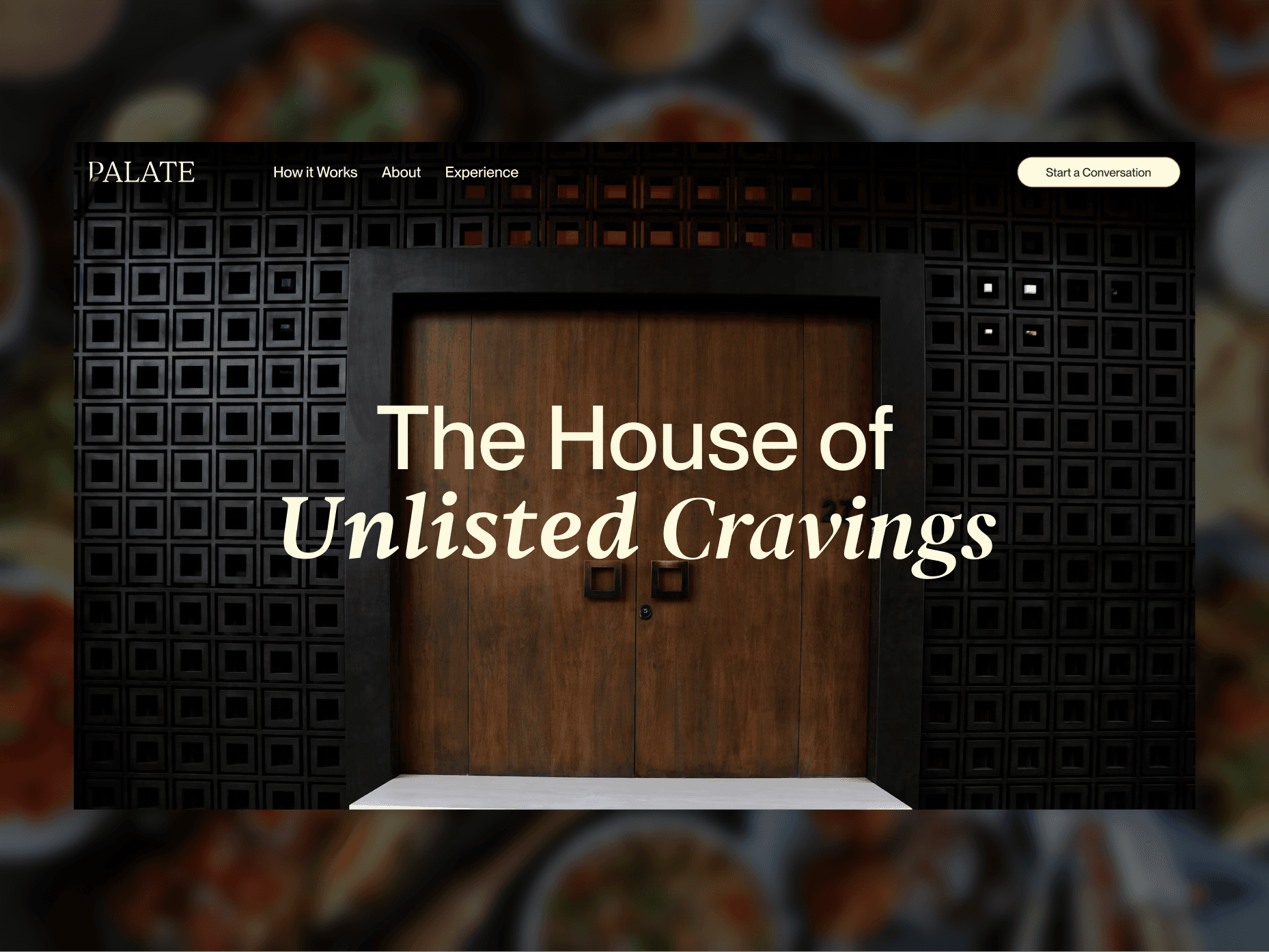
Palate is a concept food platform that reimagines ordering through conversation. Instead of browsing menus, users describe what they're craving, and the experience is shaped around them. The project explores conversational UX, emotional product design, and AI-assisted personalization.
Client
Concept Product
Service Provided
Product Strategy, UX Design, Brand Direction, Framer Development
The Problem
Food delivery platforms have solved accessibility.
They have not solved decision-making.
Users often spend more time deciding what to eat than actually ordering food. Endless menus, restaurant hopping, filters, and recommendations create an experience that feels overwhelming rather than helpful.
The deeper issue is that people rarely think about food in the way menus are structured.
Sometimes they know exactly what they want.
Other times they only know how they feel.
They might be craving something comforting after a stressful day. Something nostalgic that reminds them of home. Something warm, spicy, fresh, or familiar.
Current food platforms ask users to adapt to the menu.
I wanted to explore what would happen if the platform adapted to the user instead.
Rethinking the Experience
My initial concept followed a familiar direction.
I explored AI-powered recommendations, personalized food discovery, and smarter browsing experiences.
While these ideas improved convenience, they didn't fundamentally solve the problem.
The turning point came when I stopped thinking about food discovery and started thinking about human behaviour.
The real challenge wasn't helping users find food.
It was helping users articulate what they actually wanted.
That shift transformed the entire project.
Instead of designing another food marketplace, I began designing a system that could translate emotions, cravings, and preferences into meals.
Palate became a conversation-first experience rather than a menu-first experience.
1

The Solution
Palate allows users to begin with a feeling instead of a menu.
A user can describe a craving naturally:
"I'm feeling nostalgic today. I'm craving my grandma's pasta."
Rather than forcing them into categories or filters, the platform responds with thoughtful questions that help uncover what makes that meal meaningful.
The conversation gradually refines the request by understanding preferences, ingredients, textures, dietary requirements, and personal context.
Once the meal is defined, the request moves from conversation to kitchen, where chefs prepare it fresh according to the user's preferences.
The experience transforms food ordering from a search process into a collaborative one.
Designing for Emotion, Not Just Function
One of the biggest challenges was ensuring the product felt human.
Many AI-driven experiences lean heavily into technology and automation. While functional, they often feel cold and transactional.
Palate required the opposite.
The product needed to feel thoughtful, warm, and personal.
This influenced every design decision.
The conversational flow was designed to feel supportive rather than interrogative.
The language focused on understanding rather than efficiency.
The overall experience was built around the feeling of being heard.
Because at its core, Palate is not about food.
It's about understanding people.
Evolving the Visual Direction
The website went through several creative directions before reaching its final form.
Early explorations relied heavily on interface mockups, AI messaging, and feature-driven storytelling.
Although visually polished, they lacked emotional connection.
The breakthrough came when I realized the website should communicate the feeling behind the product rather than the mechanics.
I shifted the visual direction toward cinematic food moments, chef interactions, and human expression.
Instead of leading with technology, the website leads with atmosphere.
The imagery focuses on anticipation, preparation, craftsmanship, and the emotional relationship people have with food.
This approach helped reinforce the core idea that Palate is not simply another food platform.
It is a more personal way to experience food.
Using AI as a Design Partner
AI played an important role throughout the project, not as a replacement for design thinking but as a tool for accelerating it.
I used AI to challenge assumptions, explore alternative product directions, generate conversational scenarios, and test multiple storytelling approaches.
This allowed me to move through exploration and iteration much faster than traditional brainstorming alone.
Rather than spending time generating options, I was able to spend more time evaluating ideas, identifying stronger opportunities, and refining the experience.
The result was a more thoughtful product direction developed in a significantly shorter timeframe.
2

Key Takeaways
Palate reinforced a lesson that extends far beyond food.
The most impactful products are rarely built around features.
They are built around human behaviour.
This project taught me the importance of looking beyond the obvious problem and questioning the assumptions that shape existing experiences.
What began as an exploration of personalized food discovery ultimately became a study of emotion, intention, and how technology can help people express what they want more naturally.
More importantly, it demonstrated how thoughtful design can transform a familiar task into something that feels deeply personal.
3

Recent Designs